

A comprehensive review of executive hiring, CEO succession, leadership pipeline trends, and executive mobility across U.S. banks and credit unions, featuring insights from McDermott + Bull’s Financial Services Practice.
Executive Summary
The executive leadership market continued to evolve during the first half of 2026 as banks and credit unions responded to changing leadership pipelines, continued competition for executive talent, and evolving succession strategies. While every institution faces unique strategic priorities, several themes emerged consistently across the market.
This report combines an analysis of 496 publicly announced executive leadership appointments together with a separate review of CEO succession activity across community and regional banks and credit unions. The observations are further informed by McDermott + Bull’s executive search work with financial institutions spanning $1 billion to $100 billion in assets during the first half of 2026.
Together, these perspectives provide insight into where executive leadership demand is occurring across the organization and how boards are approaching succession planning at the chief executive level.
Three Executive Leadership Observations
1. Executive hiring remains remarkably balanced between internal promotion and external recruitment.
Despite continued investment in succession planning, nearly half of all executive leadership moves involved leaders joining from outside the organization. Internal development remains the preferred path whenever possible, but organizations continue to rely on external hiring to acquire specialized expertise, accelerate strategic initiatives, and strengthen executive leadership teams.
2. Organizations continue to seek enterprise leaders, while the market increasingly produces functional specialists.
Today’s leadership pipeline increasingly rewards functional specialization. At the same time, the supply of experienced lateral talent remains limited. As a result, organizations increasingly have little choice but to evaluate leadership capacity alongside traditional experience, recognizing that many of tomorrow’s enterprise leaders will not have previously held the exact role.
3. Leading institutions are evolving how they develop executive talent.
Rather than relying solely on traditional career progression, many organizations are intentionally broadening enterprise exposure through strategic initiatives, cross-functional leadership opportunities, board interaction, and executive mentoring. Leadership development is becoming increasingly intentional, continuous, and enterprise-focused.
About this Report
This report combines publicly available executive leadership data with observations drawn from McDermott + Bull’s executive search work across the banking and credit union sectors. Rather than simply documenting executive movement, our objective is to provide perspective on the evolving executive talent market and what these trends may mean for executive leadership in the years ahead.
Executive Leadership Market Snapshot
Executive leadership activity remained strong throughout the first half of 2026 as banks and credit unions continued investing in organizational growth, leadership succession, and specialized executive capabilities. The data reflects a balanced approach to executive hiring, with organizations continuing to invest in both internal leadership development and selective external recruitment to strengthen executive teams and position themselves for future success.
*Analysis includes 496 functional executive leadership appointments, including internal promotions and external hires. CEO appointments were analyzed separately.
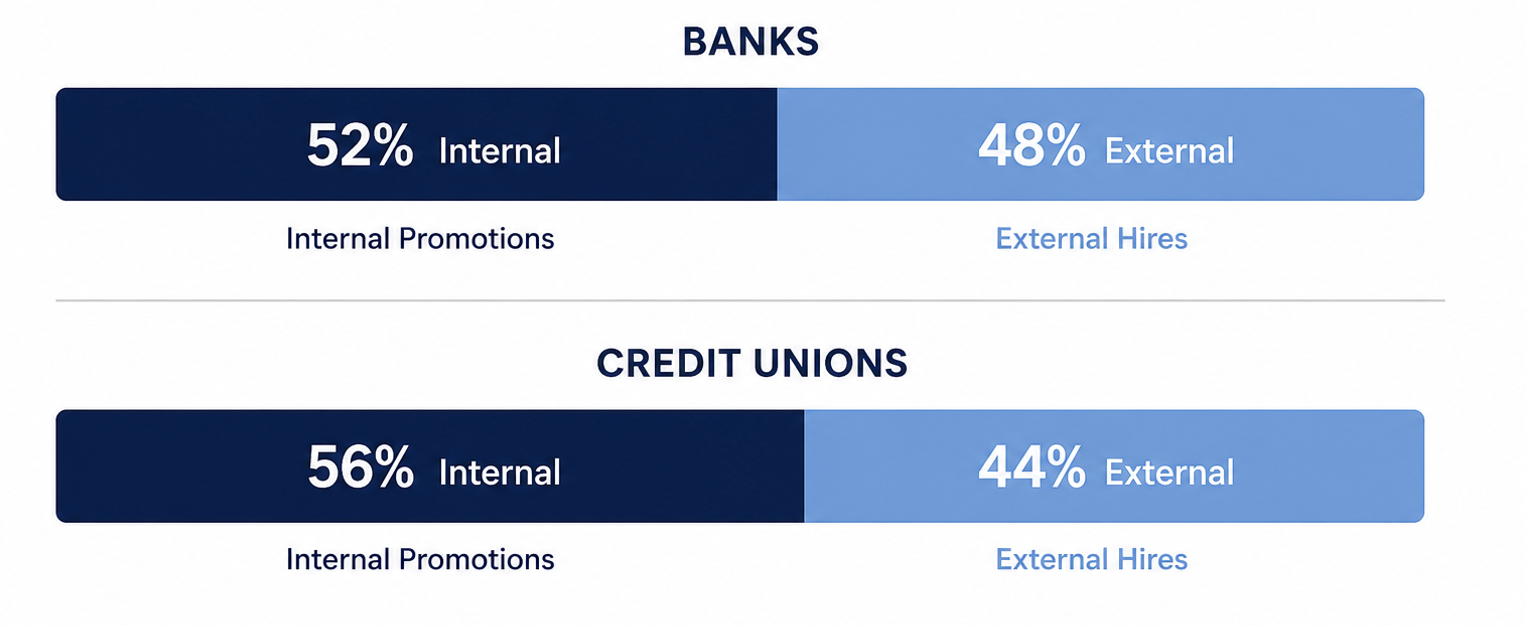
Internal vs. External Executive Leadership Moves
What We’re Seeing
Although succession planning remains a strategic priority, executive leadership continues to move through both internal promotion and external recruitment at remarkably similar rates. Across both banks and credit unions, organizations continue to prioritize internal succession whenever qualified leaders are available. External recruitment most often occurs when institutions do not have a qualified internal successor ready to assume the role.
This balance also reflects what we have experienced across executive searches during the first half of 2026. Institutions continue investing in internal leadership pipelines while recognizing that selective external hiring remains an important component of long-term executive team development.
Why It Matters
The data reinforces an important reality: internal succession and external hiring are complementary strategies rather than competing philosophies. Organizations that develop leadership internally while remaining open to exceptional external talent are often better positioned to respond to changing business priorities and future leadership transitions.
Scope of Analysis: This analysis includes publicly announced internal promotions and external hires into C-suite and senior executive roles across U.S. banks and credit unions during the first half of 2026. Executive-level individual contributor roles were excluded. CEO succession activity is analyzed separately.
Where Executive Leadership Demand Is Concentrated
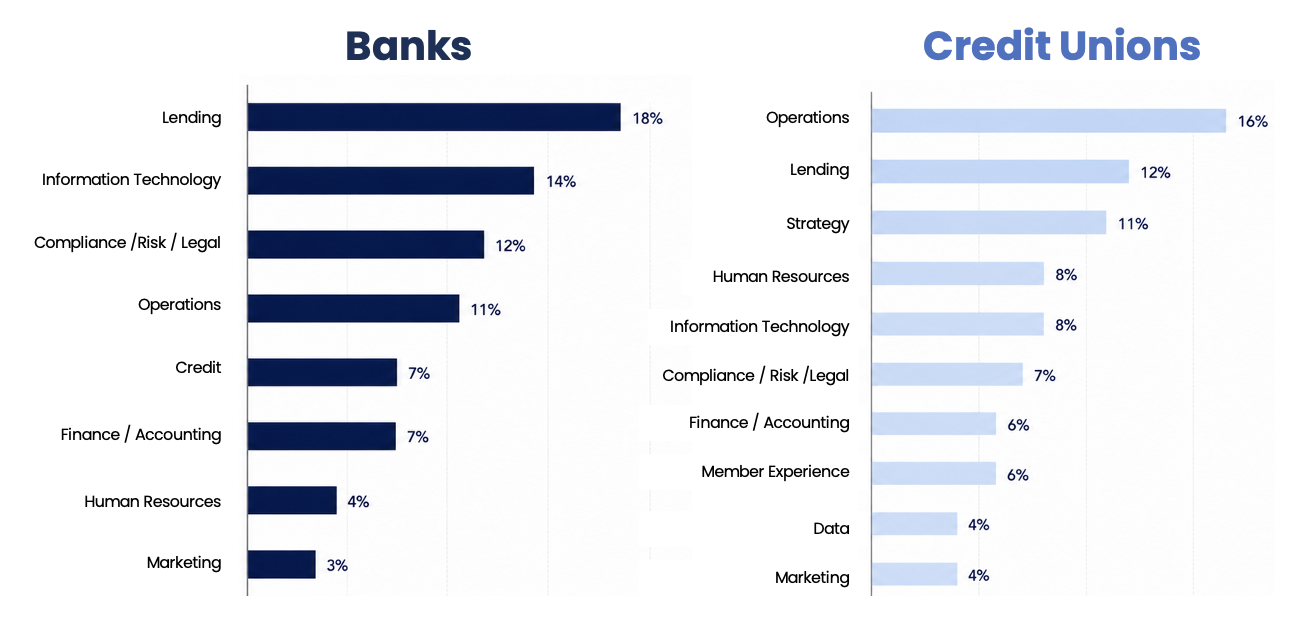
Executive leadership appointments offer more than a record of organizational change. They provide insight into where demand for executive talent is most consistently occurring across the industry. While individual organizational priorities will always vary, these patterns can help boards and executive teams better anticipate where competition for experienced executive talent is likely to be strongest.
What We’re Seeing
The hiring patterns reflected in this analysis closely align with what we have observed through our executive search work during the first half of 2026. Institutions continue prioritizing executive leadership roles that support growth, operational excellence, technology modernization, enterprise risk, and long-term organizational performance.
Although banks experienced a greater concentration of executive leadership appointments within commercial lending, executive leadership movement within credit unions was distributed across a broader range of leadership disciplines. While the distribution of executive leadership appointments differs somewhat between banks and credit unions, our executive search work suggests both sectors continue competing for many of the same executive capabilities.
Why It Matters
The distribution of executive leadership appointments provides insight into where executive talent demand is currently concentrated across financial institutions. While individual organizational priorities will naturally vary, the data highlights the executive disciplines experiencing the greatest leadership movement, offering perspective on where competition for executive talent is likely to be strongest.
CEO Succession Activity
First Half 2026
CEO succession remained an important focus during the first half of 2026 as banks and credit unions continued navigating planned retirements, long-term succession planning, and leadership transitions.
Unlike executive hiring across other leadership functions, CEO appointments typically reflect deliberate, board-led succession processes and therefore warrant separate analysis.
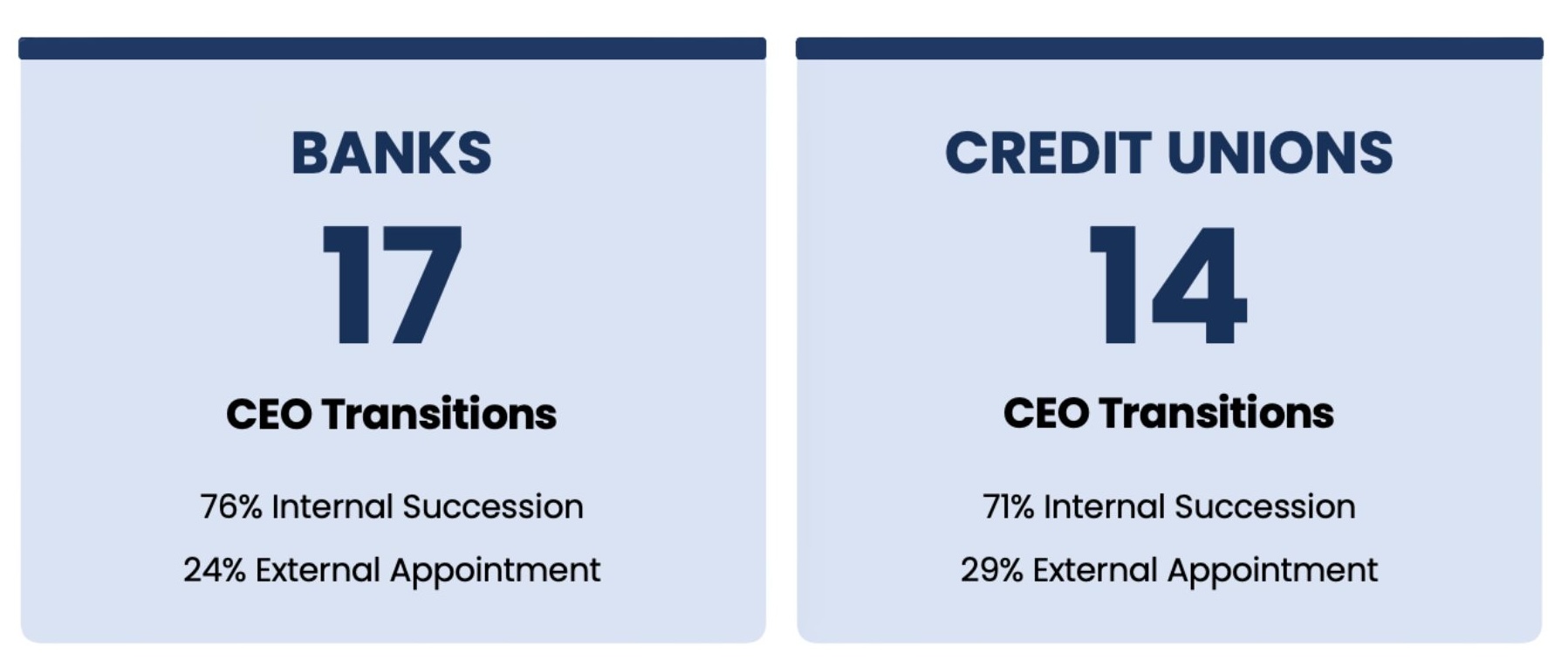
Analysis of publicly announced CEO transitions during the first half of 2026 identified 31 CEO transitions across banks and credit unions. Nearly three-quarters of these appointments were internal promotions, underscoring the continued emphasis boards place on leadership development and long-term succession planning.
Key Observations
- Internal succession remained the preferred approach for CEO appointments across both banks and credit unions, accounting for nearly three-quarters of all transitions.
- External CEO appointments were generally associated with organizations seeking specialized expertise, transformational leadership, or a strategic shift in organizational direction.
- The data reinforces that CEO succession follows a distinct pattern from broader executive hiring activity. Boards continue to rely heavily on the existing executive team as the primary source of future CEOs, underscoring the importance of developing enterprise-ready leaders well before succession decisions are made.
Source: McDermott + Bull analysis of publicly announced CEO appointments across banks and credit unions, H1 2026.
Executive Hiring Is Shifting from Experience Alone to Leadership Capacity
Across the executive talent market, prior experience in the role remains highly valued. At the same time, the market continues to experience a narrowing supply of executives who have previously held the same role, prompting boards and CEOs to evaluate leadership capacity alongside traditional experience.
Several long-term market dynamics, including executive retirements, industry consolidation, and increasing specialization, are all contributing to a smaller pool of executives with broad enterprise leadership experience. As a result, we continue to see organizations expanding the executive candidate pool by considering leaders who are stepping into a role for the first time.
Increasingly, we find ourselves discussing leadership capacity as often as prior experience. While technical expertise remains essential, boards and CEOs are placing greater emphasis on an executive’s ability to lead beyond a functional discipline, influence enterprise-wide decisions, navigate complexity, and earn credibility with boards, executive teams, employees, and external stakeholders.
The conversation is increasingly shifting from, “Has this executive done the job before?” to questions such as:
- Has this executive successfully led beyond the boundaries of their functional discipline?
- Can they influence enterprise-wide decision making?
- Have they demonstrated sound judgment through periods of change or uncertainty?
- Do they possess the leadership presence and adaptability required for broader responsibility?
These considerations are increasingly complementing traditional measures of experience.
What We’re Seeing
We continue to observe organizations broadening the executive candidate pool by considering first-time executives from institutions with greater scale. While these candidates often bring experience from more specialized roles, boards and CEOs frequently view exposure to larger, more complex organizations as an indicator of readiness for broader leadership responsibility. This dynamic increasingly allows executives to step into a larger title while moving to a smaller institution.
This shift does not reflect lower hiring standards. Rather, it reflects the realities of today’s executive talent market. As the supply of experienced lateral candidates remains limited, leadership capacity has become an increasingly important differentiator in executive hiring decisions.
Why It Matters
For boards and CEOs, evaluating leadership capacity alongside traditional experience can meaningfully expand the pool of viable executive candidates. Understanding where experienced lateral talent is limited, and where first-time executives may represent compelling alternatives, allows organizations to make more informed hiring decisions while continuing to strengthen long-term succession pipelines.
Why the Executive Leadership Pipeline is Changing
The path to becoming an enterprise executive continues to evolve.
Across many financial institutions, executives are developing deeper expertise within their functional disciplines while having fewer opportunities to gain broad enterprise leadership experience through the natural progression of their careers.
Several long-term trends appear to be contributing to this shift. Leaner leadership structures, increasing specialization, and more focused organizational roles have created highly capable executives with significant functional expertise, but often fewer opportunities to lead across multiple business lines or enterprise initiatives before reaching the executive level.
As a result, boards and CEOs are increasingly evaluating executives whose leadership potential extends beyond the breadth of their formal experience. Leadership capacity is becoming increasingly important because the traditional pathways to developing enterprise leaders are less common than they once were.
What We’re Seeing
Across our conversations with boards, CEOs, and executive candidates, leadership development is becoming increasingly intentional.
Rather than relying solely on promotions to broaden an executive’s experience, organizations are creating opportunities for emerging leaders to participate in enterprise initiatives, strategic planning, board presentations, acquisition integration, cross-functional projects, and other experiences that expand organizational perspective.
The objective is no longer simply preparing executives for their next role. Increasingly, organizations are preparing future leaders for broader enterprise responsibility long before succession decisions are made.
Why It Matters
As the executive talent market continues to evolve, enterprise leadership experience is becoming less a product of career progression and more the result of intentional development.
Organizations that create opportunities for high-potential leaders to broaden their perspective may be better positioned to strengthen succession pipelines, expand the pool of future executive candidates, and reduce dependence on an increasingly limited supply of experienced lateral hires.
How Organizations Are Responding to a Changing Executive Talent Market
The executive talent market continues to evolve, and organizations are adapting in a variety of ways. While every institution’s approach is different, several themes have consistently emerged across our executive search work during the first half of 2026.
Beyond Traditional Lateral Hires
While experienced lateral candidates remain highly sought after, the supply of proven lateral talent is limited. Many are relatively new in their current roles, firmly established within their organizations, or well positioned to remain where they are.
As a result, boards and CEOs are increasingly considering candidates who have not previously served in the role. In these situations, we frequently see clients place significant value on experience gained at institutions of greater scale, even when the candidate’s current responsibilities may be more narrowly defined. For many organizations, scale itself is viewed as an important indicator of readiness for the next leadership opportunity.
Broadening Executive Experience Before Promotion
Organizations are becoming increasingly intentional about expanding executive experience before promotions occur.
Enterprise initiatives, strategic planning, board interaction, cross-functional leadership opportunities, acquisition integration, and other enterprise-wide assignments are helping emerging leaders develop broader organizational perspective while remaining in their current roles.
These experiences strengthen succession pipelines while preparing executives for broader leadership responsibilities over time.
Competing Beyond Compensation
Executive candidates continue evaluating opportunities through a broader lens than compensation alone.
Greater organizational visibility, broader leadership responsibility, closer interaction with senior leadership and boards, organizational influence, and the opportunity to shape strategy all remain important components of an institution’s executive value proposition.
For many executive leaders, these opportunities continue to differentiate organizations in an increasingly competitive talent market.
Closing Perspective
Executive leadership hiring has never been solely about filling open positions. Increasingly, it is about understanding the dynamics of a changing executive talent market and positioning organizations to compete effectively within it.
While hiring priorities will continue to evolve, organizations that consistently attract exceptional executive talent often combine thoughtful succession planning, intentional leadership development, and a compelling executive value proposition.
Understanding the market is only part of the equation. Successfully competing for executive talent requires recognizing where demand is increasing, where experienced leaders are becoming more difficult to find, and where leadership capacity may represent the next generation of executive talent.
As the executive talent market continues to evolve, competitive advantage will increasingly belong to organizations that understand not only where executive talent is today, but where it is developing for tomorrow.
Authors

Brandon Biegenzahn
President
biegenzahn@mbexec.com
Brandon Biegenzahn serves as President of McDermott + Bull and chairs the firm’s Financial Services Practice. He is responsible for the firm’s continued growth and expansion while advising boards of directors and executive leadership teams on executive search, CEO succession, and executive assessment. Brandon’s clients include banks, credit unions, investment banks, asset managers, institutional investors, fintech companies, and family offices.

Courtney Wade
Partner
wade@mbexec.com
Courtney serves as a Partner at McDermott + Bull and co-leads the firm’s Financial Services Practice, based in Irvine, CA. In this role, she leads talent assessment, execution strategy, and overall practice operations. With over a decade of experience in executive search and recruiting, Courtney brings a relationship-driven and execution-focused approach to helping financial institutions attract and retain transformative leadership.