

Where organizations invest in leadership says something about what matters most to their business.
Companies turn to McDermott + Bull Interim Leaders during important transitions: a transformation, an unexpected executive vacancy, an acquisition, a carve-out, or a project requiring specialized expertise. While these needs exist across industries, the sectors generating opportunities shift over time.
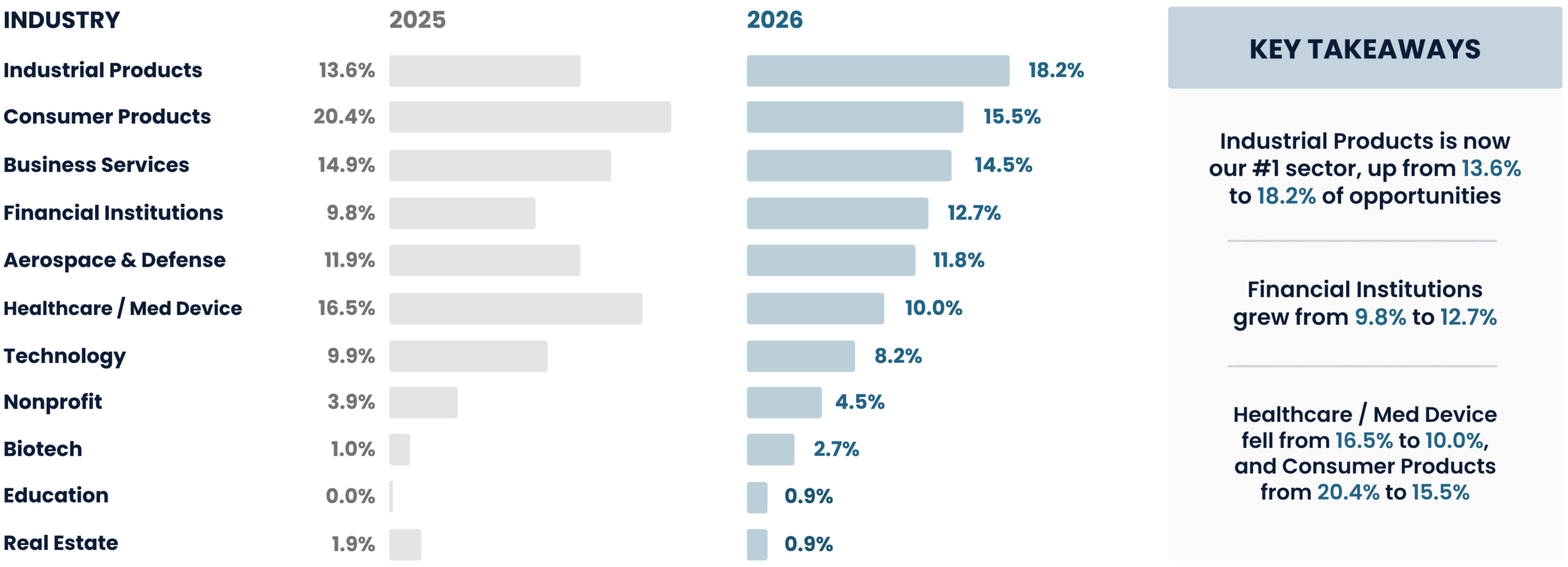
Our review of recorded opportunities in 2025 and 2026 revealed several meaningful changes. Industrial Products and Financial Institutions grew their share of activity, Aerospace + Defense and Business Services held steady, and Healthcare and Consumer Products declined.
Together, these patterns offer a snapshot of where organizations are engaging interim executives and the business priorities behind those decisions.
Where the Opportunity Mix Has Shifted
Share of recorded opportunities by industry, 2025 versus 2026.
About the Data
The findings describe McDermott + Bull Interim Leaders’ opportunity mix—not a representative survey of the entire interim executive market.
Industrial Products Takes the Lead
Industrial Products became McDermott + Bull Interim Leaders’ largest industry category, increasing from 13% of recorded opportunities in 2025 to more than 18% in 2026.
This shift comes amid increased investor interest in industrial businesses. Private equity firms and strategic acquirers are pursuing opportunities tied to domestic manufacturing, supply-chain resilience, automation, infrastructure modernization, and the growing demand for physical products supporting AI and data centers.
For manufacturing and distribution companies, pursuing these opportunities requires strong operational capabilities. Many of our interim projects in this sector focused on improving inventory management, supply-chain processes, and supporting systems.
The increase in our opportunity mix suggests that organizations are committing leadership resources to strengthen performance and support their growth plans.
Financial Institutions and Fintech: Share Nearly Doubles
Financial Institutions’ share of opportunities nearly doubled, increasing from 6.8% to 12.7%. Most of these projects focused on risk management, regulatory compliance, or leadership during mergers and acquisitions.
This activity reflects broader developments in financial services. After several years of uncertainty, bank consolidation regained momentum in 2025 and continued into 2026. At the same time, financial institutions faced more complex challenges in cybersecurity, fraud prevention, regulatory compliance, and operational risk.
As these demands converge, banks, credit unions, and fintech companies are turning to interim executives with the specialized expertise to navigate them.
Aerospace + Defense: Sustained Investment and Demand
Aerospace + Defense held steady at approximately 12% of our opportunities in both 2025 and 2026.
This consistency comes as the industry attracts significant investment and undergoes substantial change. Emerging defense technology businesses are moving from product development to commercial production, while established aerospace suppliers work to meet growing customer demand.
For companies across the sector, that growth requires expanding manufacturing capacity, strengthening financial infrastructure, navigating government contracting, improving supply-chain resilience, and operating more efficiently.
The steady share of our opportunity mix reflects the ongoing role of experienced interim executives in moving growth initiatives forward as these companies scale.
Business Services: Steady Demand for Scalability and Operational Efficiency
Business Services remained one of our largest industry categories, accounting for approximately 15% of opportunities in both 2025 and 2026.
This consistent demand reflects continued private equity and strategic investor interest in business services companies, particularly those with recurring revenue, established customer relationships, and opportunities to scale through acquisitions.
For professional services, outsourced business functions, and technology-enabled services firms, capturing that value requires building businesses that can scale, integrating acquisitions, improving profitability, and using automation to improve service delivery.
Even as new deals face more scrutiny, those operating priorities remain, and organizations continue to bring in interim leaders to carry them out.
Healthcare and Consumer Products: A More Selective Investment Environment
Healthcare and Consumer Products made up notably smaller shares of our opportunities in 2026, a decline consistent with a more disciplined approach to capital allocation among private equity firms and strategic investors.
In Healthcare, this shift comes amid reimbursement uncertainty, rising operating costs, and pressure on profitability. Investors continue to favor technology-enabled healthcare, specialized services, and businesses with strong financial fundamentals, placing greater weight on predictable earnings and operational efficiency.
Consumer Products faces similar caution, driven by shifts in spending, tariff uncertainty, supply-chain costs, and pressure on margins. Capital continues to flow to differentiated brands and businesses with strong growth potential, even as fewer transactions move forward across the broader middle market.
The decrease in our opportunity mix suggests that organizations in these sectors are focusing on essential initiatives and looking for a clearer return before committing leadership resources.
A Broader Signal: Selective Commitment Across Sectors
No single industry made up more than 20% of our 2026 opportunity mix. Across sectors, boards, investors, and management teams sought interim leaders to address specific business priorities.
Those priorities ranged from pursuing growth to managing risk, but the goal was the same: bring in experienced leadership to protect or build enterprise value.
What This Means for Business Leaders and Investors
The shifts point to differences in where organizations are committing resources. In some sectors, investment supports expansion, modernization, and acquisitions. In others, profitability, risk management, and operational stability take priority.
For business leaders and investors, the common thread is execution. Scaling manufacturing operations, integrating acquisitions, strengthening regulatory oversight, and improving financial performance all require leaders who can turn plans into measurable results. An experienced interim executive can help move that work forward while protecting enterprise value.
Investment priorities will keep shifting. The organizations that pull ahead will be the ones with the right leaders in place to act on them.

Julie Francis
Managing Director, McDermott + Bull Interim Leaders
jfrancis@mbexec.com
Julie Francis serves as a Managing Director for McDermott + Bull Interim Leaders, where she identifies and secures highly skilled executives to address client companies’ critical business challenges, provide interim leadership, and oversee special projects. She works with executive leadership at middle-market and enterprise-level companies as well as with investment banks and private equity groups to improve operational and financial performance.